Navigation principale Internet (mobile)

      • Who are we?
      • ECO Decoding
Connect me
      • FR
      • EN
Home - Economic research

Navigation principale Internet

  • Who are we?
  • ECO Decoding

Search

      • FR
      • EN

User account menu

    Connect me
    • Log in
  1. Home
  2. Search
  3. GEOPOLITICS – What the midterms won’t change: the breakdown of political compromise
Image principale
GÉOPOLITIQUE – Ce que les Midterms ne changeront pas : la crise du compromis politique
United States
Geopolitical issues

GEOPOLITICS – What the midterms won’t change: the breakdown of political compromise

28 October 2026
 - 
Content type
ECO Publication
Copy link
Download Report

Nos experts

Contacts / Experts
Image
Tania SOLLOGOUB
Prénom
Tania
 
Name
SOLLOGOUB
Chief Geopolitical Officer
Sommaire

1. From affective polarisation to the end of bipartisan compromise

2. Don’t Look Up: how emotions shape our capacity for collective action

3. How has US voters’ relationship with political violence changed since the attack on the Capitol?

4. From “Great Alignment” to “political sorting”: a long-term phenomenon

5. From inequality to social distance: the infrastructure of polarisation

6. Support for authoritarian leaders: what does political science tell us?

7. What comes after Trump?

8. From affective polarisation to institutional weakening
 

Body

The loss of US influence is accelerating. Is this down to the Trump effect? Yes, particularly among allies, but there’s more to it than that. The trend is longstanding and widespread, and points to a fundamental feature of hegemonic cycles: the decline of a power does not simply come down to a change in the balance of power; it has its roots in a crisis within the political and institutional model that underpins its legitimacy.

Contacts / Experts
Image
Tania SOLLOGOUB
Citation

Affective polarisation functions as a social identity: the individual develops hostility based on moral rather than political considerations.
Electoral defeat can then become intolerable, leading people to disregard institutional constraints.
Bipartisan compromise thus ceases to play its intended role within the institutional framework. Worse, it is seen as a betrayal of identity, increasing its “electoral cost”, with the result that elected officials are increasingly disinclined to compromise.

Contacts / Experts
Prénom
Tania
 
Contacts / Experts
Name
SOLLOGOUB
Contacts / Experts
Intitulé de poste
Chief Geopolitical Officer

Executive summary

Body

In reality, US hegemony is based just as much on military, commercial, technological and financial power as it is on the ability to make rules and give its model universal reach. Mickey and the “American way of life” are just as important as the dollar. The US political crisis and the erosion of America’s international influence are thus related: the interaction between the two is a key variable in the global geopolitical scenario.

However, the nature of US internal political polarisation has changed. Its roots go back a long way, to the political and social realignments of the 1960s. While social media have greatly increased the potential rewards of this polarisation, they did not create it. Above all, the clash of ideologies has mutated into “affective polarisation” – where the political rival is no longer simply someone who holds different views, but is morally reprehensible. In 2022, 72% of Republicans and 63% of Democrats said they considered supporters of the opposing party to be more immoral than other Americans, up from 47% and 35% in 2016. As a result, electoral competition is becoming a battle over who can legitimately govern, and compromise is seen as betrayal. Therefore, institutional transgressions are an acceptable price to stop an opponent who has become an existential enemy from winning... 

This development does not mean all Americans have become extremists. Rather, it is the culmination of a long process whereby political, social and cultural identities have become increasingly aligned. In fact, income and wealth inequalities and geographical disparities have become intertwined, dividing Americans in terms of not just their standard of living but also their lived experience. In segregated and endogamous societies like this, there are fewer opportunities to interact with people from other social groups: broader inequality creates social distance, which fuels political hostility. Polarisation becomes a self-sustaining process: each camp has fewer and fewer experiences that might challenge its perceptions of the other.

This polarisation limits the scope for compromise. The risk no longer arises from one set of policies giving way to another, but from challenges to the very legitimacy of those seeking to govern. And this perpetuates a fundamental contradiction in the contemporary political economy: public spending increases – on defence, meeting the needs of an ageing population, the energy transition, social protection – while debt limits budgetary room for manoeuvre. But fiscal slippage also reflects an inability to choose between competing demands from different sections of society and establish the legitimacy of the political coalitions making those choices. Debt becomes a way of putting off choices society is no longer able to make, and the debt crisis is also a crisis of political legitimacy.

Polarisation is where economics, politics and geopolitics converge. It undermines policy continuity, the ability to absorb shocks, and the predictability of the world’s foremost power. Beyond the midterms, then, the question is how to rebuild the democratic compromise. Above all, the coming months will show whether the electorate punishes confrontational politics or whether it continues to call on each side to wield its power in increasingly radical ways. In the first scenario, a period of political compromise could emerge, ushering in a phase of depolarisation. In the second, the US would enter uncharted institutional territory: a democracy with competitive elections, but where each change of government calls into question the limits of presidential power, or even the fundamental rules of the political system.


Body

To full analysis

Create an alert

Creating a search alert will be saved in your personalized “Your selection” space and will also activate a personalized email notification.

On the same subject

Image principale
Scénario monde
Macroeconomic Scenario
Global panorama
World – Scenario 2026-2027: layers of risk are piling up
Date de publication
02 October 2026
 • 
Type de contenu
ECO Publication
Image principale
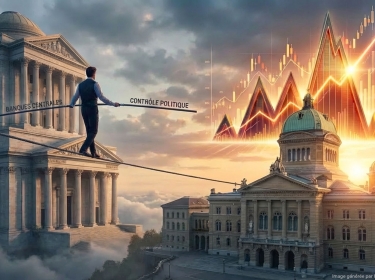
Les banques centrales ne doivent être ni sous contrôle,  ni hors de contrôle
Global panorama
Central banks must be neither under control nor out of control
Date de publication
12 February 2026
 • 
Type de contenu
ECO Publication
Image principale
usa fed
United States
USA – What would Chair Kevin Warsh mean for the Fed?
Date de publication
03 February 2026
 • 
Type de contenu
ECO Publication
Image principale
Geopolitical issues
Geoeconomics – Has geopolitics tamed markets?
Date de publication
15 January 2026
 • 
Type de contenu
ECO Publication
Footer logo

Footer top navigation - Internet

  • Who are we?
  • ECO Decoding
  • Contact and assistance

My alerts

Subtext

Personalize my content and recieve alerts by e-mail

Manage preferences link
Configure my preferences

Social network - Internet

Pied de page - Internet

  • Legal
  • Personal data
  • Cookies