Sommaire
1. European industry in survival mode
2. Towards an integrated industrial vision at European level
3. Turning innovation into industrial strength
4. Complex systems as the driving force behind reindustrialisation
1. European industry in survival mode
2. Towards an integrated industrial vision at European level
3. Turning innovation into industrial strength
4. Complex systems as the driving force behind reindustrialisation
Control over industrial value chains now sits at the heart of competitiveness, technological leadership and strategic sovereignty for the world's leading economies. European reindustrialisation rests on three inseparable conditions: bold strategic choices, organised cooperation despite its contradictions, and a capacity for innovation closely linked to the industry. Exploring an industrial model based on the design and integration of complex systems is a key pillar for strengthening Europe’s position.

CitationEurope’s ability to build robust value chains will depend as much on its realistic assessment of its limitations as on its capacity to organise genuine industrial complementarities between Member States and partners.
Faced with a structurally unstable geopolitical environment and the fragmentation of the global economy, the industrial choices made by European players with a focus on profitability have led to vulnerabilities that have now been identified, and which Europe is seeking to address. Dependence on fragmented value chains currently limits its ability to strengthen its economic, technological and industrial sovereignty.
For decades, Europe has staked its future on a ‘happy’ form of globalisation. It has fragmented its value chains, outsourced upstream segments, abandoned select industrial capacities deemed unprofitable, too capital-intensive or too far removed from end markets, and concentrated its efforts on downstream activities, notably design, marketing and services. This choice was not illogical in a stable geopolitical environment, but it has become a source of vulnerability in a fragmented world. The succession of shocks over the past six years (the COVID pandemic, the war in Ukraine, trade tensions, the war in Iran) has highlighted a fundamental reality. An economy that does not control its critical value chains exposes itself to a loss of strategic autonomy.
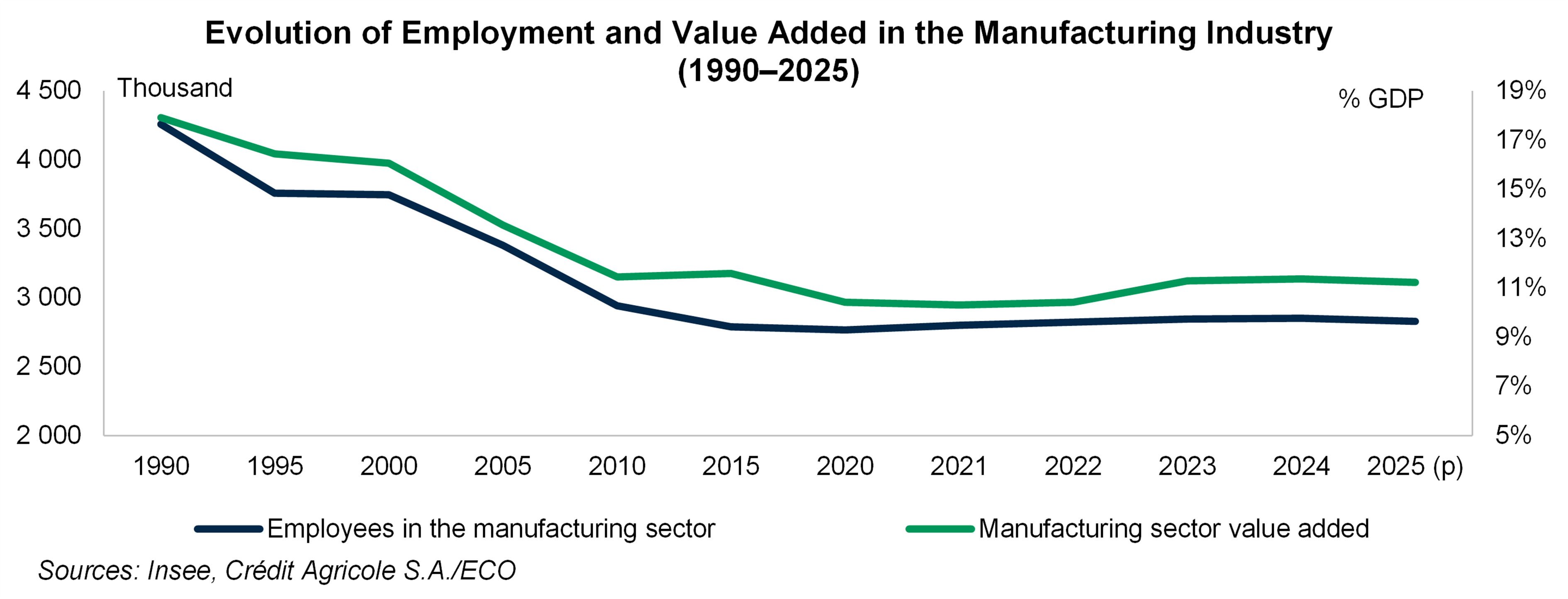
In France, following a sharp decline between the 2000s and 2020, industry has now levelled off at a plateau. Industry’s share of GDP remains stable1, as do industrial employment and the rate of new business set-ups, with no real take-off in sight. In other words, industry is showing resilience, but is still struggling to generate genuine growth momentum.
In practical terms, reindustrialisation cannot be conceived of on a strictly national scale. It requires enhanced European cooperation, which remains heavily constrained by the tensions inherent in the very construction of the European Union: diverging industrial interests, budgetary trade-offs, competition between Member States and the fragmentation of strategic priorities.
Europe’s ability to build robust value chains will depend as much on its realistic assessment of its limitations as on its capacity to organise genuine industrial complementarities between Member States and partners.
Unless it secures its key value chains, the European Union will remain dependent on its most strategic links, and thus exposed to external industrial and commercial decisions. Europe must adopt a differentiated, sector-by-sector approach in order to identify the sectors that are truly strategic, whilst taking into account those already largely controlled or dominated by third parties.
Strategic autonomy requires embracing a logic of vertical integration of value chains, with clear choices. Industrial sovereignty is not simply proclaimed; it is built, link by link. This long-term timeframe will, in practice, limit access to certain opportunities, particularly regarding critical inputs. Progress has, in fact, already been made in this direction at European level, notably through the definition of critical raw materials and the development of major projects of common European interest (PIIECs) in certain key sectors.
Today, whilst it is tempting to explain the gap between Europe and China either in terms of costs or by contrasting democratic and autocratic models, one of the most fundamental differences lies in the way an industrial vision is structured. This distinctive feature of the Chinese approach is reflected in an integrated approach to value chains. As soon as a sector is deemed strategic, China adopts a strategy of securing the entire value chain, successively consolidating control over the upstream, core industrial and downstream segments. Where it lacks domestic resources, it invests heavily abroad. Where a link in the chain is weak, it moves up or down the chain to secure the whole.
Europe’s aim is not to copy the Chinese model, but to draw a key lesson from it: it must have a clear vision and align its industrial, financial and political systems with this long-term trajectory. In this context, Europe possesses unique strengths. Through its industrial diversity, the richness of its ecosystems and its ability to combine innovation, regulation and cooperation between states, it constitutes a unique structure.
Turning innovation into industrial strength
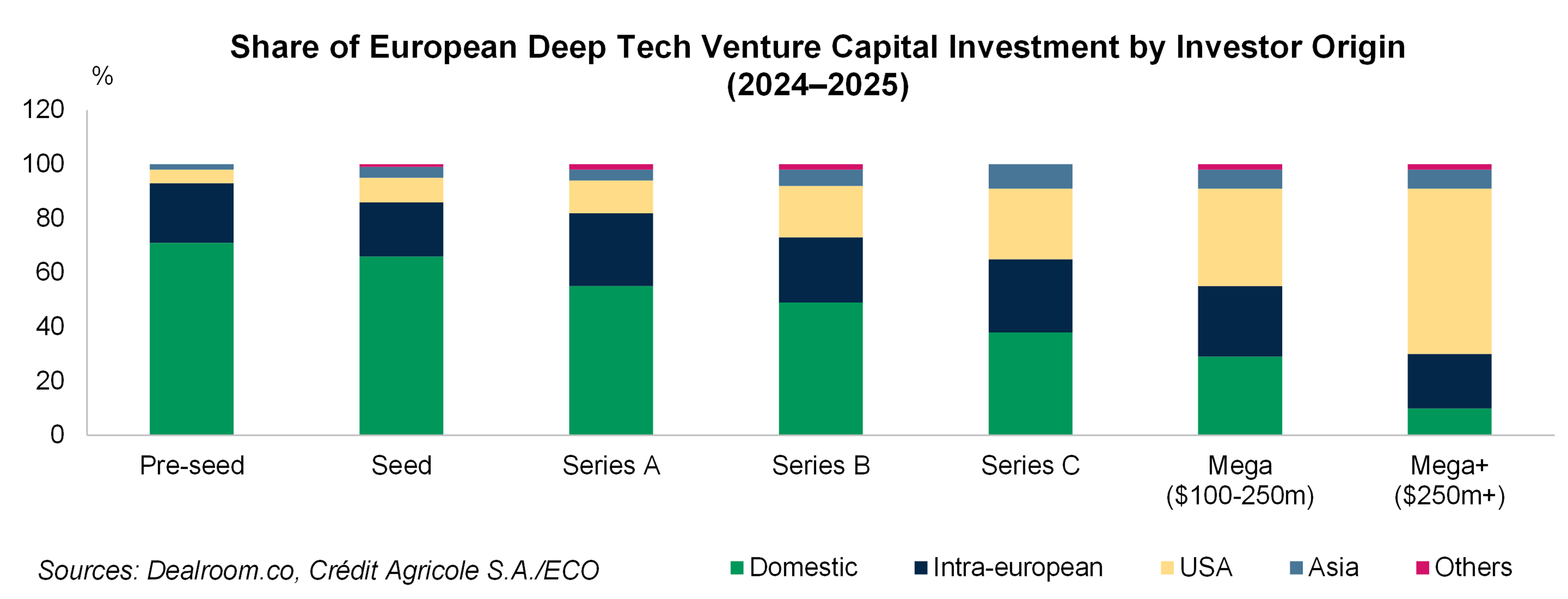
The challenge of securing this potential is compounded by a form of industrial haemorrhage of European innovation. Between 2014 and 2025, numerous European start-ups were acquired or secured funding outside the continent, with a total valuation of close to 1,200 billion euros in 20262, reflecting the scale of this outflow of value.
This trend can be explained by structural factors that limit Europe’s ability to foster industrial champions from its innovations. Despite a high level of excellence in research and technological innovation, scaling up remains more difficult due to more limited access to large-scale funding, a market that remains fragmented, and a lack of integration with industrial outlets. This fragmentation hinders the mobilisation of capital in Europe. Consequently, a European-wide capital markets union would be a key lever.
Against this backdrop, some high-potential start-ups are shifting their centre of gravity outside Europe to accelerate their development. This trend is often accompanied by a gradual transfer of intellectual property, decision-making powers and value creation to other ecosystems. The challenge, therefore, is not so much a loss of innovative capacity as the difficulty in maintaining funding, industrial roots and economic viability until the business reaches maturity.
In an environment of heightened technological competition, the challenge of reindustrialisation is therefore not merely to produce more, but also to master key technologies, whether these be advanced materials, artificial intelligence, electronics or biotechnology. Innovation can no longer be considered in isolation from the industrial ecosystem. It must be integrated into value chains, funded over the long term and aligned with clearly identified industrial priorities.
Envisioning a massive reshoring of offshored industrial activities would be unrealistic and even counterproductive. The real trend at work is that of a targeted reconfiguration of value chains.
Sectors such as pharmaceuticals, defence, aerospace, space, semiconductors and critical metals illustrate this restructuring. The solutions lie in strategies for diversification and circularity, in strengthened intra-European collaboration, and in the emergence of more resilient and sustainable regional value chains. This restructuring can also be underpinned by targeted relocations, made possible by process innovation, which enable certain stages of production in Europe to become competitive once again.
These sectors have great potential to once again become powerful drivers of industrial growth, where the challenge goes beyond simply meeting an immediate need. The aim is to strengthen – and in some cases even rebuild – productive, technological and organisational capacities over the long term, and above all to regain control over them.
This momentum is now extending well beyond these sectors themselves. A growing proportion of French industry is involved, whether in defence or healthcare, through robotics, electronics, software, materials, production equipment and biotechnology. Many civilian SMEs are joining these ecosystems, often by integrating new links into the value chain. This momentum spreads expertise, justifies investment and drives both automation and ramp-up.
It also highlights an often-underestimated strength: European – and particularly French – excellence in the engineering of complex systems3. Whilst some focus primarily on mass production and economies of scale, France can distinguish itself at European level through its ability to integrate advanced technological components and guarantee a high level of reliability. It also stands out for its expertise in demanding industrial environments, whether in defence, aeronautics, space or critical pharmaceutical supply chains.
From now on, the future of industry no longer rests on individual products, but on comprehensive solutions that integrate hardware, software, data and artificial intelligence. The major industrial battles of the coming decades will centre on complex, sovereign systems, which are set to become integral to value chains. These will be a key driver of power and strategic autonomy for Europe, with France having a key role to play.
1 INSEE
2 Cerqueiro, P. M., & Stamm, L. (25 March 2026). Europe’s Tech Exodus Drained $1.4 Trillion in Value, Study Shows. Bloomberg News.
3 A complex industrial system is not merely a product, but an integrated architecture combining hardware, software and data, the value of which depends on the ability to manage the interactions between its various components. It is in this capacity for integration that a growing proportion of industrial value now lies.