Navigation principale Internet (mobile)

      • Who are we?
      • ECO Decoding
Connect me
      • FR
      • EN
Home - Economic research

Navigation principale Internet

  • Who are we?
  • ECO Decoding

Search

      • FR
      • EN

User account menu

    Connect me
    • Log in
  1. Home
  2. Search
  3. Asia – In the Hormuz trap
Image principale
Asie – Dans le piège d’Ormuz
Asia and Oceania
Geopolitical issues

Asia – In the Hormuz trap

27 March 2026
 - 
Content type
ECO Publication
Copy link
Download Report

Nos experts

Contacts / Experts
Image
Sophie WIEVIORKA
Prénom
Sophie
 
Name
WIEVIORKA
Economist
Sommaire

1. The big risk: dependence on oil from Hormuz

1.1 A still heavily carbon-intensive energy mix
1.2 Supply dependent on Hormuz

2. Other things to keep an eye on: gas, aluminium, fertilizers and plastics

3. Transmission channels: value chains, inflation and remittances

3.1 Monitoring critical value chains that depend on these inputs
3.2 Watch out for inflation in the most fragile countries
3.3 Tourism and remittances: the importance of human flows

4. Iranian front leaves US allies exposed

4.1 The opening up of the Iranian front also redraws the geopolitical map in Asia
4.2 What about China?

5. Consult our last publications
 

Body

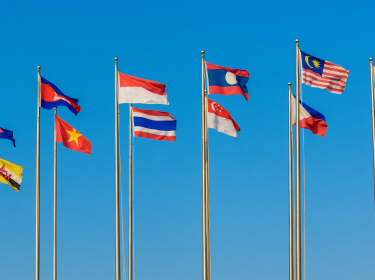
Open and tightly integrated into international trade, Asian countries are exposed to the disruption caused by the ongoing conflict in the Gulf. Most of them have reacted quickly, worrying about the impact of the war on energy supplies and trade flows. 

Body

The number one risk transmission channel is, of course, oil: suppliers to Asian countries are mainly located in the Gulf, resulting in a direct impact on prices and energy-intensive value chains. In this regard, just about every country in the region is affected, with Indonesia and Malaysia – both oil producers (albeit still net importers) – having a slight edge. 

Other raw materials and intermediate goods that pass through the Strait of Hormuz also need to be monitored: gas, of course, which powers production chains in North Asia (South Korea, Japan, Taiwan) and India; and aluminium, plastics made from oil residues, and fertilisers, where a shortage or a sharp increase in prices could weaken the Indian and Indonesian agricultural sectors. 

As the conflict drags on, the issue of human flows will become increasingly central: tourist flows to Southeast Asia (Malaysia, Philippines, Thailand) – much of which passed through the Gulf from Europe – and, above all, flows of workers. For some countries (India, Philippines), the matter of remittances from diaspora populations is far from trivial.

Lastly, the United States’ traditional allies (South Korea, Japan and Taiwan) are already worried about transfers of military manpower and defence capabilities deployed in the area thus far. This shift towards a new conflict zone reinforces the idea that these countries will have to rely more than ever on their domestic and regional resources, rather than on the US, to ensure their security and maintain the necessary deterrence against neighbouring hostile powers (China, North Korea and Russia).

Contacts / Experts
Image
Sophie WIEVIORKA
Citation

The ongoing conflict joins the list of shocks already suffered by Asian economies since 2020: Covid-19 which, for some countries, including China, lasted until 2022; the inflationary shock triggered by the war in Ukraine; uncertainties over US import tariffs. While such shocks are ultimately absorbed, they leave visible scars on economies.

The Hormuz blockade once again poses a significant inflationary risk to these countries, against which subsidies remain the only effective tool – if they can afford such measures. Beyond the issue of energy, which exacerbates the weaknesses and dependencies of these carbon-based economies, other value chains will be at the heart of concerns. The issue of fertilisers, which goes hand in hand with food security, will thus be central if the conflict drags on.

Contacts / Experts
Prénom
Sophie
 
Contacts / Experts
Name
WIEVIORKA
Contacts / Experts
Intitulé de poste
Economist

Create an alert

Creating a search alert will be saved in your personalized “Your selection” space and will also activate a personalized email notification.

On the same subject

Image principale
India
India – After China in 2001, is India embarking on a new trade odyssey?
Date de publication
20 February 2026
 • 
Type de contenu
ECO Publication
Image principale
China
China – Will the Fire Horse balk at the jump or run at full gallop? How will it affect China’s five-year plan?
Date de publication
29 January 2026
 • 
Type de contenu
ECO Publication
Image principale
Geopolitical issues
Geoeconomics – Has geopolitics tamed markets?
Date de publication
15 January 2026
 • 
Type de contenu
ECO Publication
Image principale
Corée du Sud : un an après la crise politique, les marchés achètent les promesses de stabilité
Korea (South)
Emerging countries
South Korea: a year after the political crisis, markets are buying the promise of stability
Date de publication
18 December 2025
 • 
Type de contenu
ECO Publication
Footer logo

Footer top navigation - Internet

  • Who are we?
  • ECO Decoding
  • Contact and assistance

My alerts

Subtext

Personalize my content and recieve alerts by e-mail

Manage preferences link
Configure my preferences

Social network - Internet

Pied de page - Internet

  • Legal
  • Personal data
  • Cookies