Two indicators show that, despite strong Q1 figures, the closure of the Strait of Hormuz has had an impact: the import and export curves have crossed and consumer and producer price indices have risen.
Q1: consumer spending still at a standstill
Five-year plan: priorities
The first quarter was marked by the Chinese New Year holidays followed by the presentation of the 15th five-year plan (covering the period 2026−2030) at the annual meeting of the National People’s Congress. This was an opportunity for China to unveil the broad stokes of its economic policy for the next five years and set its 2026 growth target (“between 4.5% and 5%”).
The 15th five-year plan is firmly in line with the previous plan, continuing to focus on developing industry and catching up with technological advances. While part of the plan is focused on supporting consumer spending, specific measures remain very incomplete and unclear. The authorities emphasise the need to strengthen social protection, not so much in pursuit of a consumerist agenda but rather with a view to developing human capital.
Contributions to Q1 growth are in line with this overall picture. Consumer spending contributed 2.3 percentage points (pp) of growth, investment 1.9 pp and foreign trade 0.8 pp. This means consumer spending accounted for less than 50% of growth, compared with between 60% and 70% before Covid.
The widening gap between supply and demand
Retail sales, which had picked up slightly at the beginning of the year, buoyed by the Chinese New Year and longer holidays, have once again lost momentum, up 1.7% in March; they now include digital services, which will make year-on-year comparisons less rigorous for the next year. With few exceptions (e.g. May 2025), retail sales momentum remains far weaker than overall growth, and is increasingly decorrelated from industrial production, which continues to grow faster than economic activity in general.
Industrial production was up 5.7% in March. However, this must be seen in the context of strong base effects driven by industries affected by the war (oil and gas, agricultural production). It is thus highly likely that China has reactivated some of its production capacity, either to increase strategic stocks or to respond directly to domestic demand.
Its supply-driven economy continues to be underpinned by sustained investment. While overall investment remains under pressure from the real estate sector, which has contracted for the sixth year running, investment in manufacturing and infrastructure has quickened. This investment has benefited from higher public spending and a shift in funding towards new projects, most of which are linked to new productive forces (the transition and innovation economy).
At the same time, Chinese exports have continued to grow, albeit much less quickly than in the first two months of the year (up 2.5% in March; 21.8% in January/February), notably as a result of the slowdown in global demand for finished products, with consumers already adjusting their behaviour in response to the Iran crisis. Meanwhile, imports jumped 27.8% in March (compared with a 19.8% increase in January/February). The trade balance decreased slightly, falling below $1.2 trillion. This data surprised the consensus, which did not expect exports to slow or imports to quicken to this extent.
A welcome return of inflation?
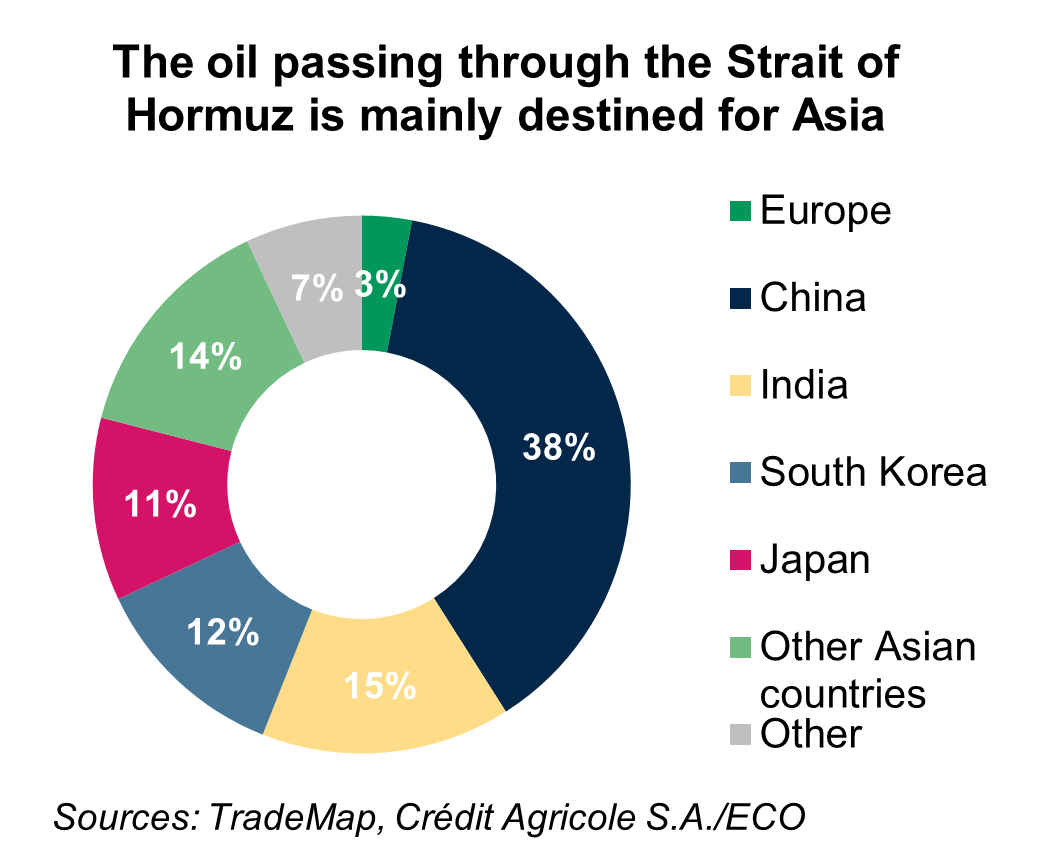
While emerging Asia faces twin shocks to both volumes and prices, and many countries in the region have already had to put in place restrictions to limit shortages (e.g. increased use of remote working, reduced speed limits on roads, fuel rationing at the pump), China does not seem to be facing any supply difficulties for the time being. Although just over 40% of its imported oil comes from the Gulf states, and notably Iran, of whose oil it was by far the largest buyer, China is able to turn to other suppliers, at least in the short term, including in particular Russia. The country also has just over three months’ worth of strategic reserves and the authorities have announced the suspension of exports of refined oil so as to maintain their reserves.
In the longer term, however, the issue of Iranian oil could become a problem. Some of China’s refineries have prospered by buying discounted Iranian crude oil transiting through Malaysia and fuelling a Chinese industrial model based in part on price competitiveness.
In the short term, the impact of the war is already reflected in producer prices, which have begun to rise (up 0.5% YoY) for the first time since September 2022. We can thus conclude that it has taken a shock of the magnitude of the closure of the Strait of Hormuz for China to emerge from deflation. On paper, this is rather good news: deflation is very bad for economies, plunging them into a vicious cycle that often leads to a decline in investment, job losses and a loss of production capacity.
However, such an analysis ignores the fact that this deflation is the result of sluggish domestic demand and, above all, an intense price war among businesses, sharply squeezing their margins and profits. Despite economic growth of 5% in 2025, industrial companies grew their profits by just 0.6% over the same period.
This phenomenon of “involution” − a form of unbridled and excessive competition that results in this kind of profitless growth – has not yet run its course, despite “campaigns” run by the authorities, notably because consolidation has yet to take place in the hardest hit sectors (electric vehicles, solar panels, batteries), where there is still excess production capacity.
China’s emergence from deflation thus has nothing to do with the rebalancing of supply and demand through adjustments to production volumes; rather, it is driven by higher production costs. This means the latter are likely to feed through into prices and, above all, penalise economic activity.
Meanwhile, consumer prices have yet to be affected by rising energy costs. On the contrary, inflation moderated between February and March (coming in at 1.3% in February and 1% in March), notably due to stabilising food prices. Higher producer and consumer prices are also mitigated by the yuan’s appreciation against the dollar. Since the beginning of the year, the Chinese currency has fallen to less than seven yuan to the dollar and is now trading at around CNY 6.8 to the dollar, a level not seen since January 2023, helping curb imported inflation slightly.
Lastly, amid the current global shock, China still has a role to play. On the one hand, it has been building its strategic autonomy for over a decade; on the other, since this is a global shock, China retains a comparative advantage relative to other countries hit harder by rising energy prices and lacking the same negotiating power with suppliers.
Hormuz adds further fuel to China’s ambitions for autonomy
Since Xi Jinping came to power, China has pursued a strategy of gradually increasing autonomy, through various channels:
- Securing value chains for supplies of raw materials via the Belt and Road Initiative
- Investing huge amounts in research and development so as to limit the use of foreign technology as far as possible
- Developing the legal framework to protect Chinese interests in the name of the “national security” principle theorized since 2015
In the 15th plan, economic security is now a cross-cutting objective, integrated into every aspect of Chinese economic life.
Innovating for energy independence
The authorities are already using the war in Iran − which is affecting significant Chinese interests (notably access to cheap energy) − to justify action through the three channels referred to above.
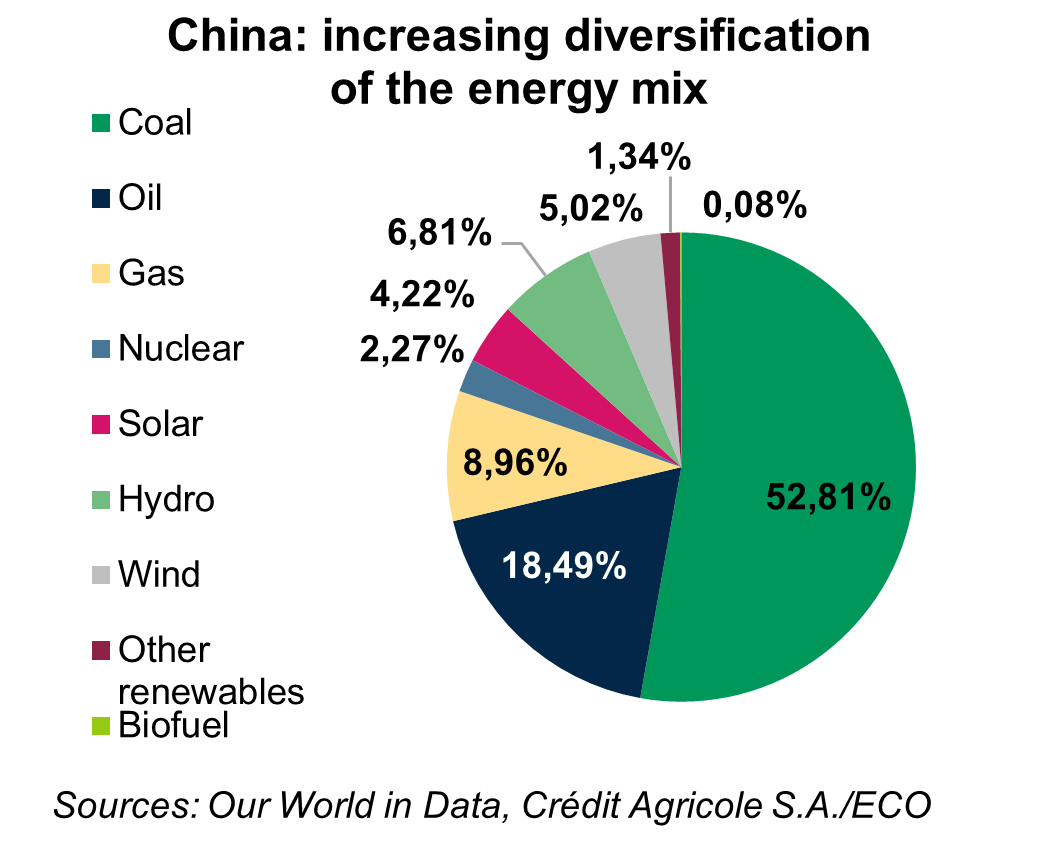
First and foremost, the war lends credibility to China’s energy policy. While China is still the world’s leading importer of oil, the share of renewables in its overall energy mix has risen considerably. China thus aims to transform its energy system towards a mix dominated by low-carbon sources: its target of installing 1,200 gigawatts of wind and solar capacity by 2030 has already been achieved, and the country is now moving towards its long-term target of achieving carbon neutrality by 2060, with renewables accounting for 80% of electricity production.
Access to cheap energy is one of the pillars of China’s industrial strategy. That being the case, the war in the Middle East will also prompt the country to step up its investment in research and development to identify new alternatives to fossil fuel. For example, battery giant CATL recently announced the launch of an electric vehicle battery with a range of 1,500 km, far exceeding its predecessor’s 1,000 km range. Chinese manufacturers are also racing to innovate to shorten charging times (nine minutes for BYD, six for CATL).
The 15th plan highlights the need to maintain a monopoly on rare earths and critical metals as well as strategic industrial bases and reserves and stocks of raw materials. Building this kind of resilience also means tapping into China’s hinterland, while its most highly developed areas (the eastern part of the country, and particularly the provinces of Guangdong, Fujian, Zhejiang and Jiangsu) are focused on innovation and high value-added production.
The spread of artificial intelligence, whose status has shifted in the 15th plan from that of a mere tool to a systemic infrastructure component, is also part of this dynamic.
Strengthening the legal arsenal in support of “national security”
The National Security Law has already been supplemented several times, notably with a law on export controls in 2020 providing for strict regulation of trade in dual-use goods, as well as regulations on foreign investment controls.
Beyond the 15th plan, the most striking recent development − albeit as yet not widely reported – is the publication of two regulations in keeping with this trend.
The first is aimed at securing industrial and supply chains. While these concepts are not clearly defined, they provide Beijing with an opening to sanction foreign companies suspected of harming Chinese national security by manipulating information related to value chains (e.g. in the field of market research, already heavily affected by data laws) or even changing their production and supply policies. The derisking strategies put in place by some foreign companies could thus be considered harmful to national interests, resulting in sanctions. Under pressure, companies would have less room for manoeuvre.
Meanwhile, the second regulation concerns efforts to combat the abuse of extraterritorial jurisdiction by foreign countries. Here again, the concepts are – intentionally – defined very loosely. This regulation paves the way for sanctions against companies, whether Chinese or foreign, that comply with extraterritorial measures, particularly those emanating from the US. The CK Hutchison case (involving the sale of interests in port terminals to a consortium led by US company BlackRock, notably in Panama, without the prior agreement of the Chinese authorities), and of course the blockade of the Strait of Hormuz, probably hastened its publication. The Chinese government’s response has been extremely wide-ranging, running the gamut from fines and criminal prosecutions to visa suspensions and blocked investments. For Chinese firms, the regulation also reverses the burden of responsibility: until now, Chinese companies that complied with foreign extraterritorial measures could simply report such compliance to the authorities; from now on, they will be required to obtain authorisation before complying with such measures.
This regulation confirms that China is adopting a more aggressive strategy and turning the weapons traditionally used by the US against it, particularly in terms of extraterritoriality. As part of this strategy of weaponising value chains, China has also adopted various export control measures. The European Chamber of Commerce in China has revealed that the country made use of export controls more than 30 times between 2021 and 2025, compared with 11 times over the previous period (2015−2020). These measures are a response to restrictions imposed by the US, particularly in the semiconductor sector.
Moreover, this strategy was also used in the US-China negotiations triggered by the reciprocal tariffs introduced on “Liberation Day” in April 2025: the threat that China might introduce export controls on rare earths and critical minerals was surely one of the arguments that finally prompted the Trump administration to back down.
These new regulations have been published ahead of a meeting between Xi Jinping and Donald Trump scheduled to take place in mid-May. They enable China to prepare a potential response to new tariffs that could be imposed by the US under Section 301, after the Supreme Court overturned general reciprocal tariffs, or under the Uyghur Forced Labor Prevention Act, which aims to prohibit the entry into the US of goods made using forced labour.