Navigation principale Internet (mobile)

      • Who are we?
      • ECO Decoding
Connect me
      • FR
      • EN
Home - Economic research

Navigation principale Internet

  • Who are we?
  • ECO Decoding

Search

      • FR
      • EN

User account menu

    Connect me
    • Log in
  1. Home
  2. Search
  3. South Korea – The moment of truth
Image principale
Corée du Sud – Le « moment Corée » à l’épreuve du réel
Korea (South)

South Korea – The moment of truth

18 November 2026
 - 
Content type
ECO Publication
Copy link
Download Report

Our experts

Contacts / Experts
Image
Sophie WIEVIORKA
Prénom
Sophie
 
Name
WIEVIORKA
Economist
Sommaire

1. Le « moment coréen » : une hypothèse à qualifier

1.1 Le retour de la croissance
1.2 La construction d’un avantage comparatif fort : comment expliquer le succès coréen ?
1.3 Le développement du secteur se poursuit avec l’appui de l’État

2. Croissance en K, « tech dutch disease » : les pièges à éviter

2.1 Entre offre et demande, le déséquilibre persiste
2.2 La maladie hollandaise des semi-conducteurs ?

3. L’internationalisation du won, l’autre facette du moment coréen ?

3.1 Le chemin de l’internationalisation complète

4. Quelle pérennité pour le modèle coréen ?

4.1 Énergie, eau : la question des ressources
4.2 La question du contrat social
 

Body

South Korea is undoubtedly at a pivotal moment: the boom in AI and semiconductors is restoring growth, external surpluses and the leeway to undertake financial and monetary reforms, starting with the internationalisation of the won, but this momentum has not yet spread throughout the economy.

Contacts / Experts
Image
Sophie WIEVIORKA
Citation

The risk for South Korea is therefore that it will develop a two-speed economy in which the strong performance of certain sectors masks the difficulties faced by others and, in the long run, leads to a form of ‘Dutch disease’, that is to say, a technological competitiveness windfall and an AI-driven demand shock that concentrate capital, profits, talent and political attention in a highly capital-intensive sector that creates few jobs. As a result, the country could become dependent on a cyclical boom in AI demand, where prices and volumes could reverse abruptly, before stabilisation mechanisms have had a chance to be put in place.

Contacts / Experts
Prénom
Sophie
 
Contacts / Experts
Name
WIEVIORKA
Contacts / Experts
Intitulé de poste
Economist

Executive summary

Body

South Korea’s strength lies in a very specific comparative advantage: its dominance in memory components. Samsung Electronics and SK Hynix, two global vertical integrators, design, manufacture, test and market their own chips, enabling them to coordinate R&D, mass production, yields and investment on a very large scale.

South Korea’s industrial strategy currently pursues three objectives. The first is to strengthen production capacity. The second aims to reduce external dependence, particularly on China for rare earths, through the diversification of sources, strategic stockpiling, recycling and the development of a domestic sector for the separation, refining and production of magnets. The third aims to close the gap in Korea’s capabilities in the field of logic semiconductors, design and equipment manufacturing.

This success, however, raises the question of excessive dependence on a very specific sector. South Korea is experiencing not so much overall growth as a supply shock and a surge in technological investment, the benefits of which for households are delayed and unevenly distributed. Since the end of the Covid-19 pandemic, nominal wages have risen, but purchasing power has followed a highly uneven trajectory. The share of consumption in GDP remains below its pre-Covid level, and private consumption remains fragile, held back by virtually stagnant real wages, inflation above target and very high household debt.

The risk of a ‘Dutch disease of semiconductors’ is real, even if this is a sector-specific variant: a technological competitiveness windfall and an AI-driven demand shock are concentrating capital, profits, talent and political attention in a highly capital-intensive sector that creates few jobs, yet without any sustained appreciation of the won at this stage. 

The central question is therefore whether South Korea can convert this positive shock into a new, more balanced growth model, driven by consumption, services, productivity and financial depth, or whether the country risks repeating its historical vulnerability: a highly open, highly industrialised economy, yet dependent on a small number of technologies, markets and a global investment cycle.

The ultimate tension is therefore not only between growth and redistribution, but between the short-term cycle – exceptional profits and tax revenues – and structural needs – an ageing population, housing, the energy transition and regional rebalancing. It is precisely this dilemma that makes the ‘Korean moment’ both promising and still uncertain.

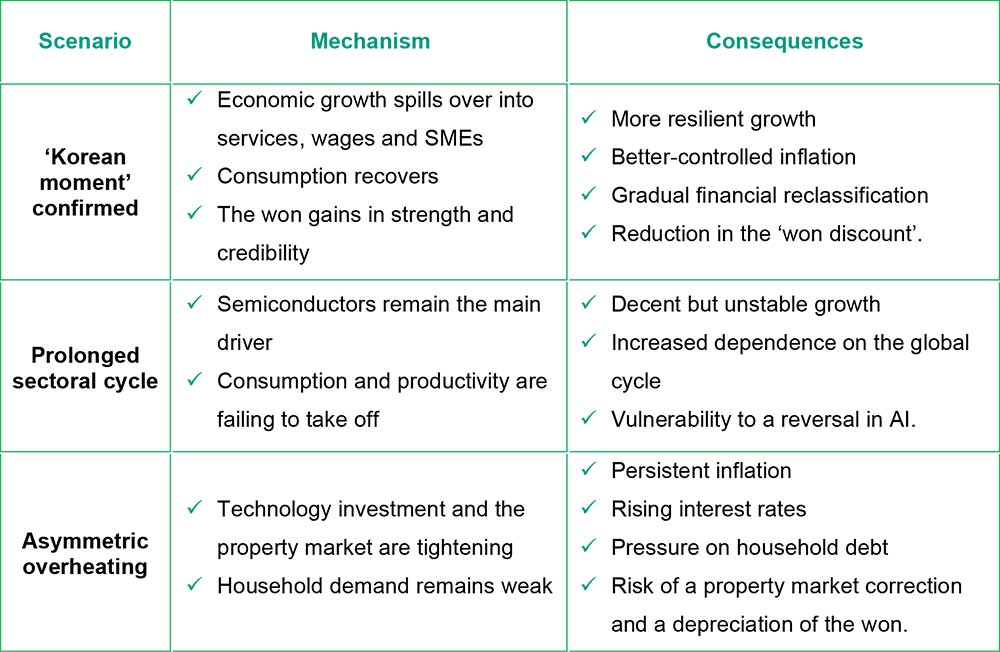
Image title
Three scenarios
Image
Three scenarios
Body

To find out more, read the full analysis

Create an alert

Creating a search alert will be saved in your personalized “Your selection” space and will also activate a personalized email notification.

On the same subject

Image principale
China
United States
China–US: ‘strategic stability’ put to the test by Chinese ambitions
Date de publication
04 November 2026
 • 
Type de contenu
ECO Publication
Image principale
Scénario monde
Macroeconomic Scenario
Global panorama
World – Scenario 2026-2027: layers of risk are piling up
Date de publication
02 October 2026
 • 
Type de contenu
ECO Publication
Image principale
Image d'illustration Drapeaux ASEAN
Asia and Oceania
Asia – Charting a course through the fog of Hormuz
Date de publication
05 June 2026
 • 
Type de contenu
ECO Publication
Image principale
China
China – Hormuz: fuelling China’s desire for autonomy
Date de publication
12 May 2026
 • 
Type de contenu
ECO Publication
Footer logo

Footer top navigation - Internet

  • Who are we?
  • ECO Decoding
  • Contact and assistance

My alerts

Subtext

Personalize my content and recieve alerts by e-mail

Manage preferences link
Configure my preferences

Social network - Internet

Pied de page - Internet

  • Legal
  • Personal data
  • Cookies