Sommaire
1. The economy is set to slow under the weight of energy prices and uncertainty
2. The energy crisis – a delayed impact
3. Bank of England: the Iran-US truce reduces the probability of a rate hike
4. Economic & financial forecasts
1. The economy is set to slow under the weight of energy prices and uncertainty
2. The energy crisis – a delayed impact
3. Bank of England: the Iran-US truce reduces the probability of a rate hike
4. Economic & financial forecasts
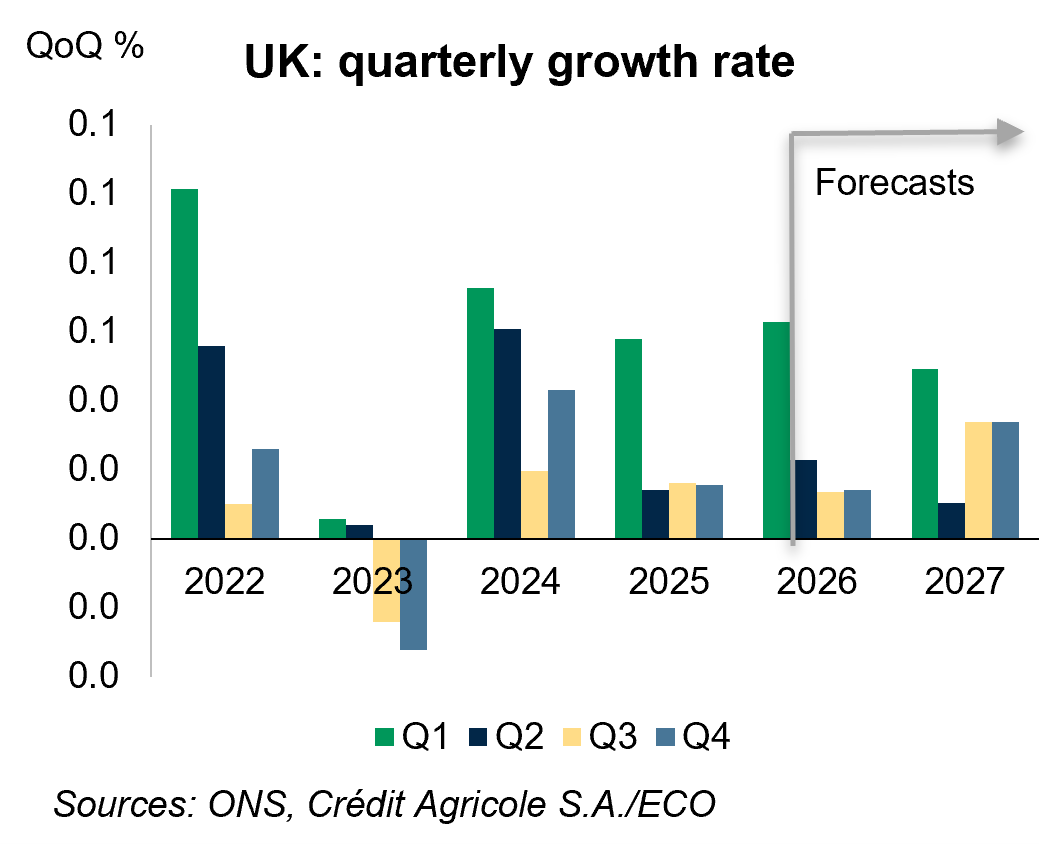
The beginning of the year was encouraging for the UK economy with a rebound in GDP of 0.6% QoQ in Q126, stronger than expected, which has led us to revise upwards our forecast for average annual growth by 0.3 percentage points to 1.1%.
However, activity is set to slow in the coming months against a backdrop of anticipated acceleration in inflation and interest rates remaining elevated, partly linked to domestic political uncertainty following Keir Starmer's resignation as Prime Minister. The Middle East conflict and its corollary, the rise in oil and gas prices and interest rates, has so far had detrimental effects on the UK economy mainly through an increase in fuel prices, pressures on businesses’ production costs and household purchasing power, as well as a negative impact on demand, primarily in the services sector. Companies are considering responding to these shocks by reducing their profit margins and, to a lesser extent, by increasing selling prices. Our initial assumption of limited wage pressures appears to be holding, at least for now. The risk of second-round effects through wage renegotiations in early 2027 cannot, however, be ruled out, with the peak of inflation anticipated towards the end of this year. Consumer price inflation is expected to average 3.4% at the end of 2026/beginning of 2027 (revised slightly downwards compared to three months ago), before falling back towards the 2% target towards the end of next year.
In this context, the Bank of England should be able to avoid tightening its monetary policy: we are removing the sole precautionary rate hike from our central scenario that we were anticipating at the start of the Middle East conflict. For 2027, we are factoring in two rate cuts in the second half, as inflation is expected to decline rapidly towards target. The main risk around our central scenario remains that linked to maritime traffic in the Strait of Hormuz and developments in energy prices. On the domestic front, uncertainty surrounding the economic and fiscal policies of the next Prime Minister and his Chancellor of the Exchequer is a source of tensions in the gilts market that should persist until at least the Autumn Budget. Investors are watching closely for any sign of abandonment of fiscal discipline by Andrew Burnham – the very likely successor to Keir Starmer.

CitationThe risks surrounding the outlook are related to the uncertainties regarding the maritime traffic through the Strait of Hormuz.
UK GDP surprised on the upside in Q126 with a rebound of 0.6% QoQ compared with Q425. This growth was driven by household consumption (+0.6% QoQ), public consumption (+0.4% QoQ) and changes in inventories (contributing +0.6 percentage points). By contrast, investment and net exports made a negative contribution. Consequently, we are revising our annual growth forecast for 2026 upwards by 0.3 percentage points to 1.1% annual average.
However, we anticipate a marked slowdown in Q226 (to 0.2% QoQ), resulting in part from a technical effect. Indeed, the apparent strength of GDP in Q1 mirrors a pattern observed almost every year since the pandemic, namely activity being concentrated at the start of the year. The Office for National Statistics (ONS) acknowledges the existence of “moving seasonality”, which is expected to be corrected over time, but the process is likely to take between three and five years. Pending this correction, our GDP forecasts incorporate a pronounced seasonal pattern, which would result in a further rebound in growth in Q127.
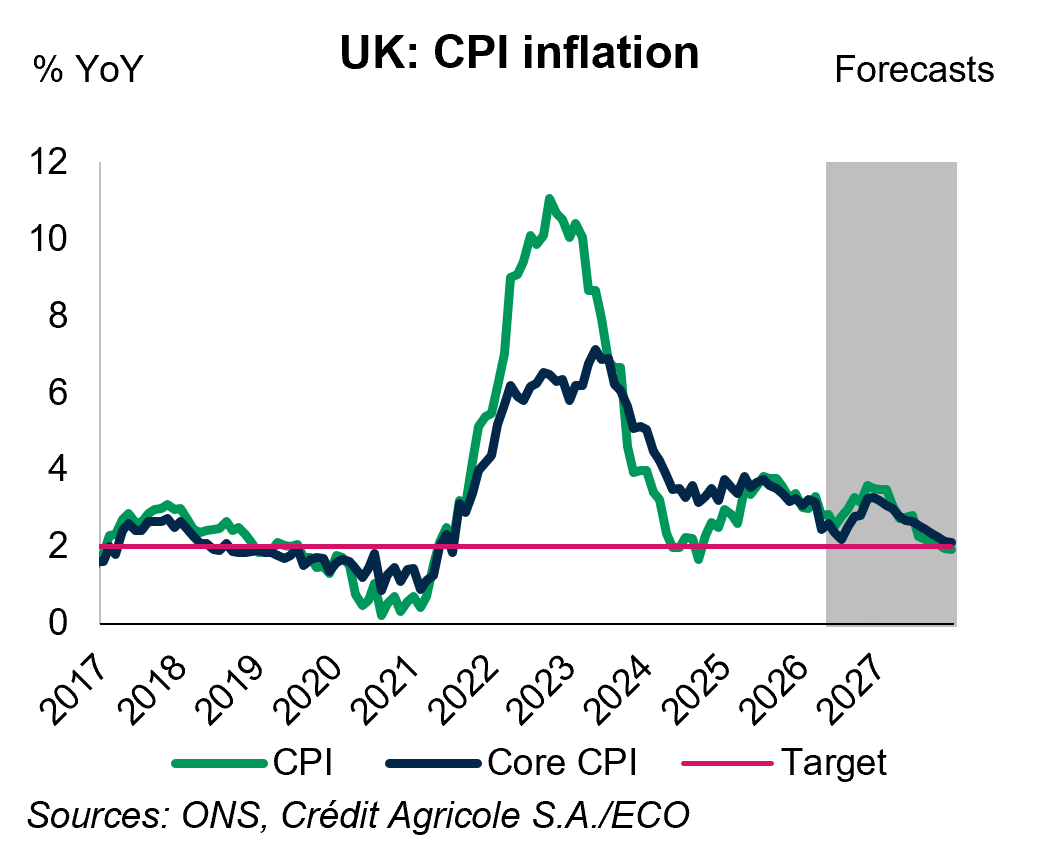
CPI inflation has been a rather pleasant surprise in recent months. It fell to 2.8% YoY in April, in line with our forecast, down from 3.3% YoY in March. It remained stable in May, below expectations (3.0% YoY): the rise in energy prices, driven mainly by higher fuel costs, was offset by a moderation in inflation rates for services and food. Gas and electricity prices, meanwhile, fell in April following the decision by the regulator Ofgem (Office of Gas and Electricity Markets) to reduce its energy price cap with effect from 1 April. This cap is calculated based on wholesale gas prices over the period from 15 November 2025 to 13 February 2026, ie, before the start of the conflict in the Middle East. This fall is also the result of measures taken by the government as part of its Autumn Budget, aimed at preserving households’ purchasing power.
The impact of the energy shock on inflation will therefore only become apparent in the inflation figures from July onwards. Ofgem will increase its energy price cap by 13.5% from 1 July, a rise very close to our initial estimate (+15%). Consequently, inflation will rise significantly in the second half of the year, peaking in November. However, the fall in oil and gas prices following the agreement between Iran and the United States will allow gas and electricity prices to resume their downward trend from October onwards.
We have revised down our inflation forecast to an average of 3.4% in Q4 (down from 3.5% previously), with a peak of 3.6% YoY in November. Inflation is expected to ease during 2027 and reach the Bank of England’s (BoE) 2% target in Q427.
This delayed but inevitable acceleration in inflation will reduce household purchasing power, against a backdrop of a deteriorating labour market. We anticipate a decline in consumption in H226. We also expect a further contraction in investment, due to pressure on corporate margins and elevated interest rates. Consequently, the risk of a recession in the coming months cannot be ruled out: only net exports will make a positive contribution to growth, due to an anticipated fall in imports. This sharp slowdown in H226 leads us to revise our growth forecast for 2027 by -0.1ppt to 1.1%.
The risks surrounding the outlook are closely linked to uncertainties regarding the maritime traffic through the Strait of Hormuz. A rapid recovery would trigger a sharper fall in energy prices. This creates upside potential for our growth forecast, which is based on the conservative assumption in our central scenario that traffic will be restored to 80% of normal capacity.
On the domestic front, the main source of uncertainty is linked to the potential leadership contest within the Labour party following Keir Starmer's resignation as Prime Minister and to the economic policies that will be pursued by the new Prime Minister.
The main risk identified by bond investors is a possible relaxation of fiscal discipline under Andrew Burnham's, who is considered as the most likely successor to Keir Starmer. Burnham advocates costly policies such as increased capital investment in infrastructure, nationalisations of key utilities and an ambitious council housebuilding programme. In the context of deteriorated public finances (budget deficit of 5.2% of GDP in 2025 and general government gross debt at 102.3% of GDP and expected to continue increasing), the question of financing such projects is very challenging.
Aware that a fiscal stimulus could trigger a crisis on the gilt markets if it were financed by increased borrowing, Burnham has already affirmed his intention to respect the fiscal rules in force. These consist of bringing the current deficit (deficit excluding capital expenditure) in balance by the third year of the forecast period (currently 2028-29), which requires day-to-day spending to be funded by tax revenues and to borrow only for investment. The government must also put the public debt ratio (measured by public sector net financial liabilities as a percentage of GDP) on a downward trajectory over the next three years.
In terms of taxation, Burnham has also committed to the Labour Party’s manifesto promise not to raise income tax, VAT or employee National Insurance. Therefore, Burnham seems to be adhering to the same constraints as Chancellor Rachel Reeves and this is considerably reducing the possibility of a large fiscal stimulus. Among the ideas he has hinted at are a property tax reform, a stamp duty reform and inheritance tax changes. However, a detailed policy package will take time to emerge.
Furthermore, the next Prime Minister will face a more deteriorated economic backdrop than before the Middle East war with weaker growth, stronger inflation and higher interest rates compared to the latest projections of the Office for Budget Responsibility. Fiscal headroom which according to the Office for Budget Responsibility's November 2025 estimates stood at GBP22bn (around 0.6% of GDP), is therefore thinner. Thus, the probability of a broad fiscal easing at the next Autumn Budget seems unlikely to us, although obviously nothing can be ruled out. Fiscal policy must remain restrictive to ensure debt sustainability and, rather than a relaxation, the government may be forced to announce further tightening in the autumn in order to establish its credibility.
The Bank of England has kept interest rates unchanged (at 3.75%) since the start of the conflict in the Middle East, whilst signalling that it remains ready to act if it judges that its 2% inflation target is at risk of becoming unattainable in the medium term. Action would be particularly warranted if the risk of second-round effects in price and wage-setting were to increase. This risk would be all the greater if the shock to energy prices were to persist. The BoE has explicitly stated that if inflation were to rise mainly due to direct effects of higher energy prices and second-round effects remained contained, a more gradual convergence towards the 2 % target would be tolerable, against a backdrop of weak economic growth. In the alternative scenario, where the rise in energy prices were to feed through to more sustained domestic inflation, the BoE indicates that the priority given to stabilising economic activity would be reduced, and monetary policy would need to maintain its restrictive stance for longer, or even tighten it further.
Given these indications from the BoE regarding the conduct of its monetary policy, the memorandum of understanding between the US and Iran, and the resulting fall in energy prices, appear to reduce the need for an immediate rate rise. This is all the more true given that the tightening of financial conditions observed since the start of the conflict is already playing a restrictive role in place of the BoE, weighing on demand and the employment outlook, and thereby reducing the prospects of inflationary pressures in the medium term. We are therefore removing our previous forecast of a rate hike from our central scenario. However, a rate rise remains a possibility should the alternative scenario materialise in the coming months.
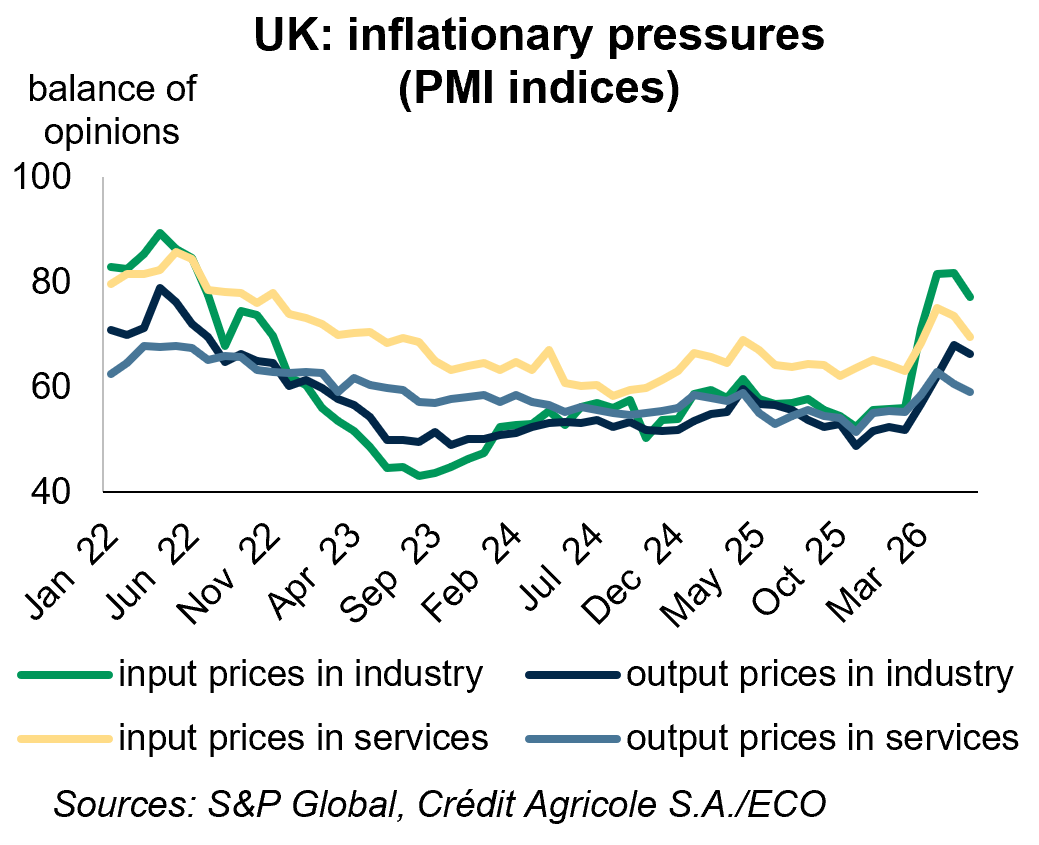
PMI surveys suggest that inflationary pressures eased somewhat in June but remain quite strong and at their highest levels since the Russian invasion of Ukraine in 2022.
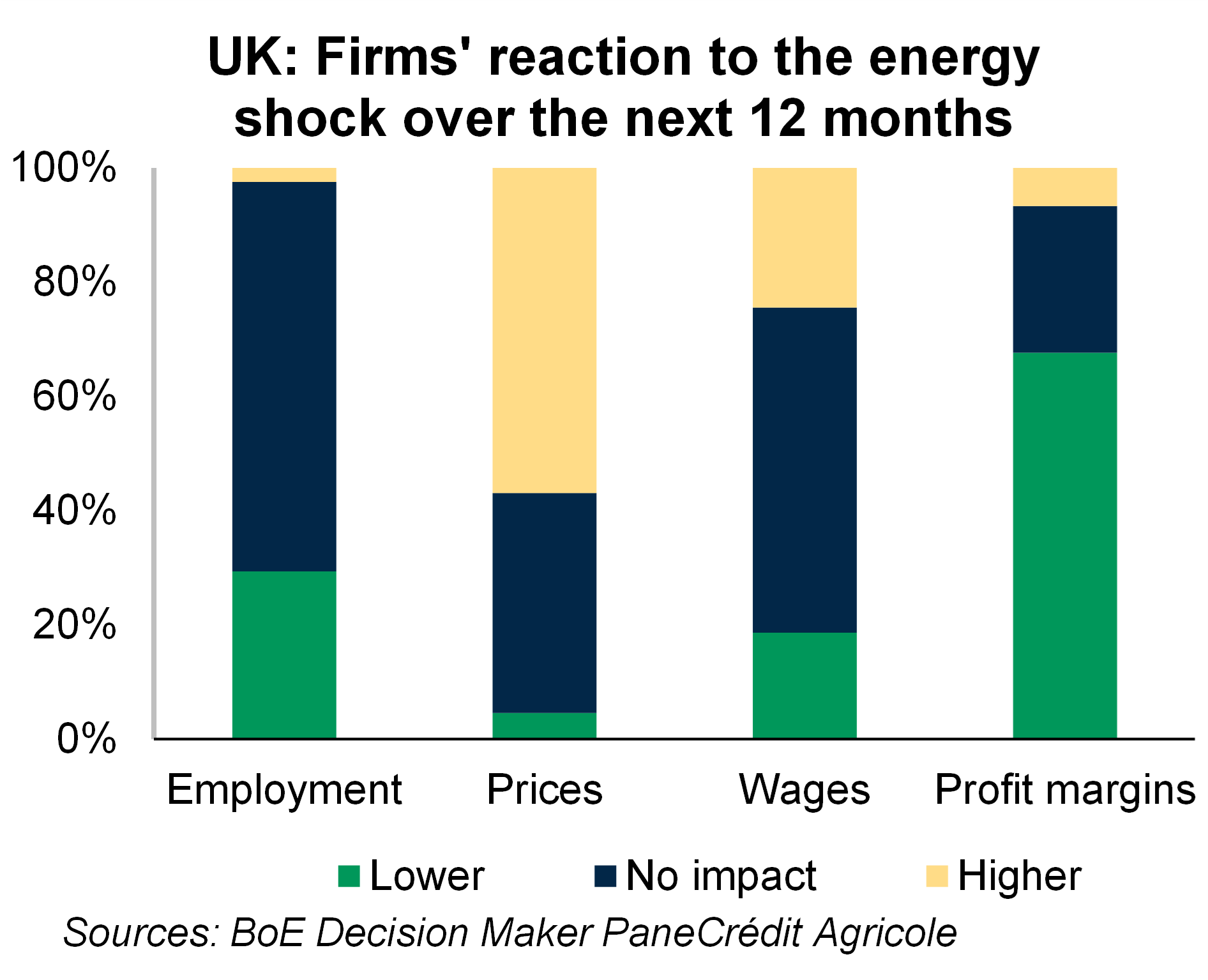
Moreover, business surveys show little impact at this stage on anticipated wages. According to the BoE’s Decision Maker Panel surveys, businesses mainly plan to respond to the energy price shock by reducing their profit margins – an option cited by more than two-thirds of respondents – and by raising their selling prices, mentioned by around half of them. By contrast, fewer than one-quarter anticipate a rise in wages. Whilst households’ inflation expectations have risen significantly, businesses anticipate a slowdown in wage growth over the next twelve months. We will also have to wait until next spring to find out the outcome of the next round of wage negotiations, which are due to take place in early 2027. Against the backdrop of an expected further deterioration of unemployment in the coming months, wage negotiations are likely to be restrained. Core inflation (2.6% YoY in May) is therefore expected to be held in check by weak demand and a rising unemployment rate. According to our forecasts, the unemployment rate would temporarily exceed 3% YoY in Q426 and Q127, returning to levels similar to those seen in early 2026, before falling rapidly over the course of next year. This should enable the BoE to resume its process of rate cuts in H227.