Recherche
50 résultat(s) trouvé(s)
2026-2027 Scenario – Spain: Between a global slowdown and domestic support
Growth in the Spanish economy remains solid at the start of 2026, although it is showing signs of moderating in a more uncertain international environment. Domestic demand – underpinned by private consumption and investment – remains the main driver of economic activity, buoyed by a labour market that remains dynamic and by the impetus of public policies. At the same time, the external sector is making a...
 Ticiano
BRUNELLO
Ticiano
BRUNELLO
2026-2027 Scenario – France: growth weakened by rising energy prices and renewed uncertainty
Economic activity slowed in 2025, whilst remaining resilient in a context of high uncertainty and rising trade tensions. The ongoing conflict in the Middle East has already resulted in higher energy prices and renewed geopolitical uncertainty. Under the assumption of a very gradual reopening of the Strait of Hormuz, without a return to normal conditions, consumer prices would accelerate on average in...
 Marianne
PICARD
Marianne
PICARD
2026-2027 Scenario – Euro area: Domestic factors are keeping the risk of recession at bay
This scenario is set against a backdrop of military, political and economic uncertainty that makes forecasting the scale of shocks and their macroeconomic impact particularly risky. But one thing is certain: the tightening of external constraints on the Eurozone, which is facing more volatile prices on global energy markets. Whilst, unlike in 2022, the risk is less one of shortages, its vulnerability to...
 Paola
MONPERRUS-VERONI
Paola
MONPERRUS-VERONI

World – Scenario 2026-2027: highly subject to change
The powerful political and geopolitical consequences of the conflict in the Middle East will extend far beyond the more immediate ones that this scenario aims to identify. This conflict is not an isolated incident, but rather it is part of a series of supply shocks (the Covid pandemic, the war in Ukraine, Houthi attacks) that highlight critical dependencies on a few key chokepoints (eg, commodities...
 Catherine
LEBOUGRE
Catherine
LEBOUGRE

2026-2027 Scenario – United Kingdom: a new ‘stagflationary’ shock
The UK economy, still bearing the marks of the 2022 energy crisis, is confronting a fresh external supply shock stemming from the war in the Middle East. The economic situation prior to this conflict was fragile: GDP growth was still very modest in the second half of 2025; the unemployment rate had risen; and a surge in inflation eroded the household purchasing power against a backdrop of moderating wage...
 Slavena
NAZAROVA
Slavena
NAZAROVA
GDP per capita in Europe: France losing ground, but not stalling
According to Eurostat data, France’s GDP per capita, measured on a purchasing power parity (PPP) basis, comes in at 98% of the European average – fixed at 100 – putting it below the latter for the third year running. This is frequently portrayed in the media as a sign that the French economy is “stalling”.
 Isabelle
JOB-BAZILLE
Isabelle
JOB-BAZILLE

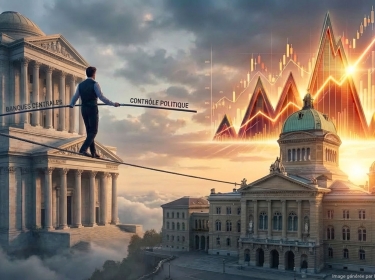
Central banks must be neither under control nor out of control
With the Federal Reserve in the throes of an institutional crisis under pressure from Donald Trump, who has repeatedly attacked Fed Chair Jerome Powell with the aim of influencing monetary policy for political ends, it is essential to reiterate the importance of the principle of central bank independence.
United Kingdom – Inflation rebounded at the end of 2025, a lull is expected for 2026
UK inflation measured by the Consumer Price Index (CPI) rebounded in December, reaching 3.4% YoY, after 3.2% YoY in November. This figure is slightly above the consensus forecast of 3.3%, but below the Bank of England's (BoE) projection of 3.5% (which we also shared).
Europe –2026-2027 Scenario: fiscal policy as a resistance tool
In an uncertain environment posing challenges to competitiveness and unable to rely on external demand, European economies are managing to accelerate activity at a pace in line with their potential. Whether through measures to facilitate disinflation or support for private and public investment, fiscal stimulus is coming to the rescue, while central banks are taking a break, with inflation fully under...
 Sofia
TOZY
Sofia
TOZY

Geoeconomics – Has geopolitics tamed markets?
It may appear surprising that the spectacular abduction by the United States of Nicolás Maduro – a flagrant violation of the United Nations Charter – has unleashed only the faintest of financial shockwaves. Not only did markets easily absorb this event, they immediately wanted to know what would happen next. There has been no massive flight to safe assets, no financial dislocation, no lasting pressure on...
 Tania
SOLLOGOUB
Tania
SOLLOGOUB