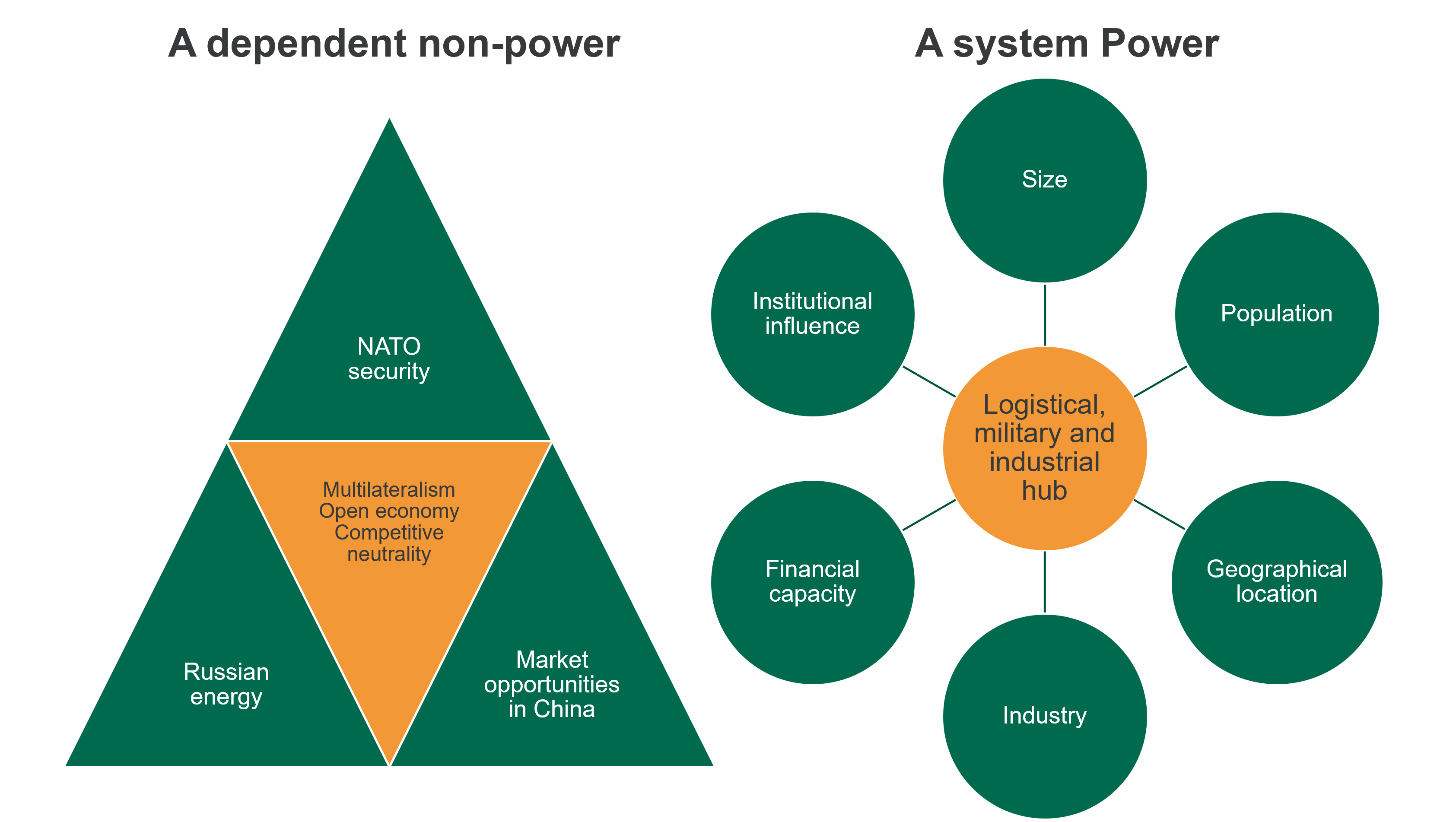
For nearly thirty years, Germany prioritised economic prosperity over a genuine geopolitical strategy. Its model rested on three pillars: American protection, Russian energy and Chinese markets. In a stable international environment, this framework enabled Germany to exert its influence primarily through the economy, whilst maintaining a doctrine of military restraint. However, recent geopolitical upheavals have transformed these interdependencies into vulnerabilities, undermining the foundations of the German model.
This shift was officially marked by the ‘Turning Point’ (Zeitenwende) announced by Olaf Scholz in 2022. The 2023 national security strategy combined strategic autonomy, economic and social resilience, infrastructure protection and military strengthening. Since Friedrich Merz came to power in 2025, this approach has been made more operational and more focused on issues of power.
Germany no longer seeks merely to reduce its dependencies; it aspires to become a ‘system power’, capable of converting its economic clout into strategic influence. Its economic and demographic size, the strength of its industry, its financial capabilities, its institutional weight and its central geographical position make it a logistical, industrial and military hub for Europe. From this perspective, defence becomes an essential element of industrial policy. Infrastructure, value chains and military capabilities are now viewed as components of a single security effort.
This development also implies a shift in the national consensus. The idea that prosperity guarantees peace has gradually given way to the view that security is a prerequisite for prosperity. This shift justifies rearmament, increased military spending and investment in infrastructure. The culture of restraint inherited from the post-war era is gradually giving way to a more traditional approach to conventional deterrence. Faced with the Russian threat, Germany now accepts military options that were once taboo, whilst maintaining strict democratic control over its armed forces in order to prevent any drift towards hegemony.
Relations with China have also undergone a profound change. Beijing is no longer seen merely as an economic partner, but as a strategic rival. Berlin, however, favours a strategy of reducing dependencies rather than complete decoupling, which is deemed unrealistic given the strong economic interdependencies. This shift is accompanied by a growing ‘Europeanisation’ of Germany’s policy towards China: Germany is acting increasingly within a European framework and drawing on the weight of the single market as a tool for negotiation and pressure.
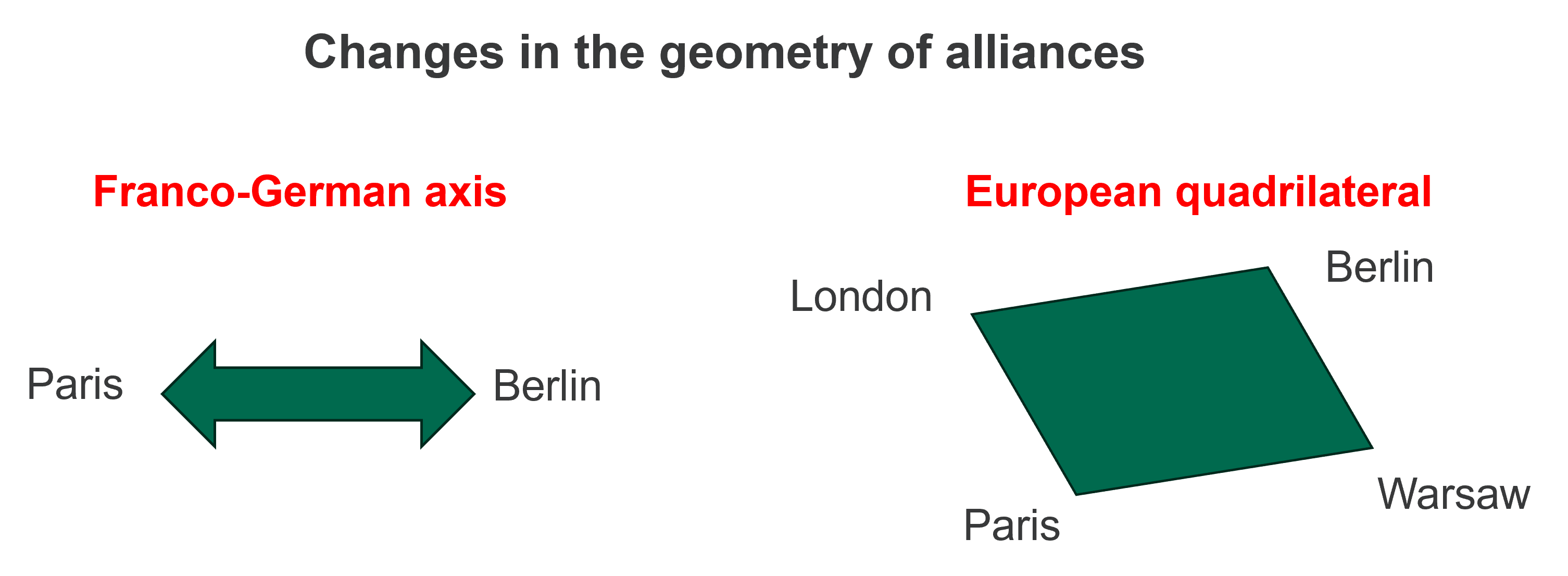
The war in Ukraine has also altered the balance of alliances in Europe. The Franco-German partnership remains central, but strategic differences persist. Whilst France equates European power with strategic autonomy, Germany prioritises strengthening European capabilities within NATO. The rapprochement with the United Kingdom illustrates this approach. At the same time, Europe’s strategic centre of gravity has shifted eastwards, as evidenced by the partnership with Poland: Germany brings its economic and industrial strength, whilst Poland contributes a strategic culture more focused on the Russian threat. More broadly, traditional alliances are gradually giving way to flexible coalitions built around specific objectives.
This rise in power nevertheless raises questions amongst European partners. The scale of Germany’s rearmament is rekindling fears of possible domination, even though Berlin insists on its willingness to act in cooperation with its allies and to strengthen NATO’s European pillar. Doubts remain, however, regarding Germany’s willingness to develop genuine shared European industrial capabilities. In particular, it remains to be seen whether its industrial power will be harnessed for integrated European programmes or whether it will primarily benefit German and American industries.
Finally, the realisation of this ambition to become a major power is by no means guaranteed. The funding required for rearmament and infrastructure has been made available, but transforming it into operational capabilities will take time. This long-term transition remains vulnerable to political changes, revisions to budgetary priorities and the rise of the AfD, which shares neither this strategic vision nor this alliance system.