Around 40 per cent of the natural gas consumed in Germany is used to generate heat for heating. To meet high winter demand, Germany also has the largest natural gas storage capacity in the European Union, accounting for just over 20 per cent of the EU total. Germany also remains the most industrialised economy in the EU, accounting for nearly 40 per cent of the chemical and metallurgical industries, which are heavy consumers of natural gas.
Acceleration of the energy transition
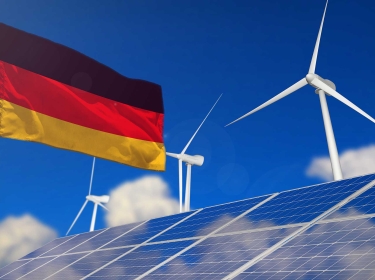
The Fukushima accident in 2011 marked a decisive turning point in Germany’s energy strategy. The federal authorities decided to phase out nuclear power and accelerated the programme to develop renewable energy, the Energiewende. Germany has thus established itself as a pioneer in the deployment of renewable energy, particularly in wind and solar power.
Above all, the rapid expansion of renewable energy has helped to offset the gradual decline in German nuclear power generation between 2011 and 2023.
However, the rise of renewable energy has only partially contributed to the replacement of coal-fired power stations and the reduction of CO₂ emissions from the energy sector. It was primarily the rise in the price of carbon from 2016 onwards that eroded the competitiveness of coal-fired power stations, encouraging their gradual replacement by natural gas-fired power stations, which have become the dominant marginal technology in Germany. Between 2015 and 2021, the installed capacity of natural gas-fired power stations thus increased by 4.5 gigawatts (GW), whilst that of coal-fired power stations fell by 7.6 GW.
Exposure to Russia
As Europe’s energy giant, Germany imports virtually all of its requirements for oil, petroleum products, natural gas and anthracite.
Before the Russia-Ukraine conflict, Russia was Germany’s leading supplier of oil and petroleum products (just over a quarter of imports came directly from Russia), natural gas and anthracite (nearly 50 per cent and 45 per cent of imports respectively). Along with Italy and some of the Baltic states, Germany was among the EU countries most exposed to Russia.
The embargo on Russian petroleum products and the halt to Russian gas supplies via the Yamal (2021) and Nord Stream (2022) pipelines have severely disrupted Germany’s energy landscape. Before the Russian invasion of Ukraine, Germany redistributed a significant proportion (40–50 per cent) of the Russian and Norwegian gas it imported.
Since 2022, natural gas flows have reversed and are now heading from north-west to east Europe. This reversal has naturally altered the natural gas price differential across continental Europe, and today, natural gas prices on the French markets are lower than those in Germany.
A central role in Europe’s electricity interconnections
Thanks to its central geographical position within the European Union and its numerous interconnections with neighbouring countries, Germany plays a key role in balancing European electricity markets.
Overall, Germany remains a net importer of electricity, with imports having risen by 20 per cent between 2023 and 2025, whilst exports have remained relatively stable. Germany imports mainly from the Scandinavian countries, France, Belgium and the Netherlands, and exports to Central European countries (Austria, Poland, Switzerland and the Czech Republic).
This balance is disrupted during periods of very low renewable energy production, known as ‘Dunkelflaute’. Germany offsets these shortfalls by reducing its exports and increasing its imports from Scandinavian countries. This preference for imports over increasing domestic production from thermal power stations has led to a very sharp rise in spot prices on the Scandinavian markets.
Future energy challenges
The 2022 energy crisis highlighted the need for greater energy self-sufficiency for Europe and for Germany. Since then, Germany has been expanding its renewable electricity capacity, without making any significant progress in the electrification of its economy. Like its neighbours, it is experiencing surpluses of intermittent electricity supply that are disrupting markets and grids.
In the coming years, Germany’s main energy challenges will be an increase in the number of hours with negative prices, the curtailment of renewable generation due to lack of demand, and grid congestion.
Iran’s prolonged blockade of the Strait of Hormuz has disrupted European supplies of diesel and kerosene, reigniting interest in Sustainable Aviation Fuel (SAF) despite very high investment and production costs.
To fully replace its consumption of mineral kerosene with SAF, Germany will need to succeed in producing synthetic fuels from low-carbon hydrogen, the large-scale commercialisation of which remains hampered by excessive costs.
Overall, climate imperatives are not the only reasons why Germany must accelerate the electrification of its economy and invest heavily in the modernisation of its electricity grids and in low-carbon synthetic fuels. Although complex and costly, this transformation is essential to guarantee Germany’s energy security and industrial competitiveness in the coming decades.