2. Wind and solar lead the way
3. Decarbonisation still incomplete
4. A favourable regulatory framework
5. Integration as the key challenge of the decade
Twenty-five years after the launch of the Energiewende, Germany has established itself as Europe’s leading producer of renewable electricity. However, the overall picture remains mixed, with the energy system still reliant on fossil fuels for 75 per cent of gross final energy consumption. The success in the electricity sector has therefore not yet been extended to the system as a whole, raising questions about the integration of variable generation, the adaptation of grids and the development of flexibility measures.
CitationThe electrification of end-use sectors determines the system’s ability to translate the success of electric power into overall decarbonisation. It is in this area that the next decade of the Energiewende will be decided.
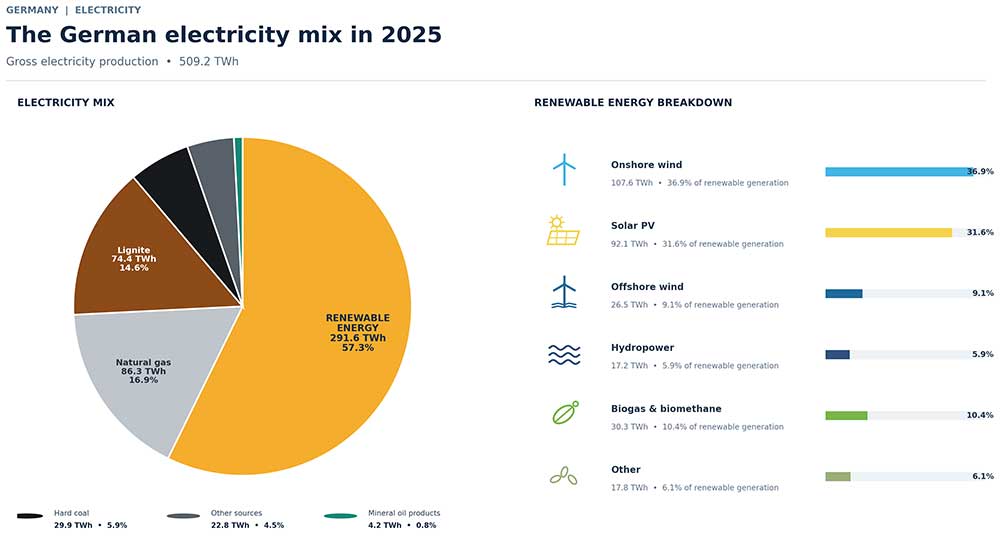
By the end of 2025, renewable energy generation had reached 292 terawatt-hours (TWh), accounting for 57 per cent of gross electricity generation, driven by onshore wind, solar and biomass, which together account for 83 per cent of the total renewable mix. Germany still lags behind Denmark and Austria, however, where renewables account for 92 per cent and 87 per cent of electricity generation respectively. France follows a different model, with 95 per cent of its electricity being carbon-free, thanks to nuclear power (68 per cent) and renewables (27 per cent).
When measured against gross final energy consumption, Germany’s share of renewables falls to 24 per cent; this gap is due to the significant weight of the heating and transport sectors, where the penetration of renewables remains very limited.
“Other” includes solid and liquid biogenic fuels, sewage and landfill gas, the biogenic fraction of waste, and geothermal energy.
TWh by renewable sub-category are calculated from UBA-published shares and are indicative. Renewable totals: 291.5 TWh (UBA) and 291.6 TWh (AGEB/Destatis).
Wind power remains Germany’s leading source of renewable energy, accounting for 27 per cent of generation with a total capacity of 78 GW. Solar power is the fastest-growing sector, accounting for 18 per cent of the mix and 108 gigawatts-peak (GWp) installed by the end of 2025. Biomass, meanwhile, accounts for 8 per cent, mainly via biogas. With over 9,300 plants, Germany has Europe’s largest network of anaerobic digestion facilities geared towards local combined heat and power generation. Hydropower and waste-to-energy round off this renewable mix, but with no scope for further development, as hydropower potential is structurally limited.
Fossil fuels still account for 38 per cent of electricity generation, dominated by lignite and gas. The capacity of coal-fired power stations, which stood at nearly 40 GW in 2021, had fallen to 30 GW by mid-2025 as a result of the Coal Phase-out Act. This trajectory was also influenced by the phase-out of nuclear power, which was completed in April 2023. Nuclear power accounted for nearly 30 per cent of electricity generation in the early 2000s; the decommissioning of nuclear reactors has reduced the system’s controllable low-carbon capacity. Renewables have offset this decline in volume, but not in flexibility, meaning that gas continues to play an important role.
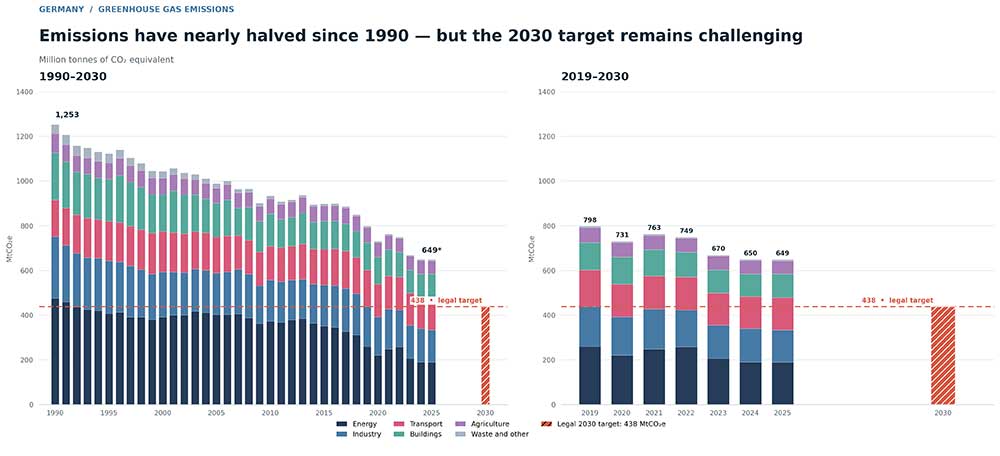
At the level of the energy system as a whole, the picture is clearer: in 2025, emissions fell by just 1.5 per cent, to 640 Mt CO₂eq. Progress continues to be concentrated in the electricity sector, whilst the buildings and transport sectors remain bottlenecks despite the growth in heat pumps and electric vehicles. In industry, certain processes still require specific solutions, such as low-carbon hydrogen or CO₂ capture for residual emissions.
Renewables have taken off thanks to a regulatory framework that has continued to evolve since the EEG1 in 2000 and its suite of incentive measures. A turning point came in 2014, with the shift to tenders, which became widespread in 2017 with the EEG 2017. Then, in 2023, the definitive phase-out of nuclear power was introduced.
The current framework aims for at least 80 per cent renewable energy in gross electricity consumption by 2030, the phase-out of coal by 2038 and climate neutrality by 2045.
Whilst the deployment of capacity remains necessary, it is no longer the decisive bottleneck. The focus is now shifting towards the storage and transmission of this electricity.
The grid is the main bottleneck: the bulk of wind power generation is located in the north of the country, whilst industrial centres are concentrated in Bavaria and Baden-Württemberg. Efforts are underway, as exemplified by TenneT, which has almost doubled its investment between 2024 and 2025. However, this falls far short of the transmission requirements by 2045, estimated by the NEP at between 360 and 390 billion euros, to which a further 200 billion euros must be added for distribution. Key interconnectors such as SuedLink, due in 2028, are intended to relieve pressure on this north-south corridor. In the meantime, congestion costs reached 3.1 billion euros in 2025, according to the Bundesnetzagentur.
Demand flexibility is becoming increasingly important as the number of hours with negative prices rises, from 459 in 2024 to 575 in 2025. A technology-neutral capacity mechanism is being put in place, but a key link is missing: barely 6 per cent of German meters are smart meters, compared with an average of 63 per cent across Europe. Battery storage and low-carbon hydrogen remain the least advanced areas of development, even though they are set to provide the controllable capacity previously supplied by nuclear and fossil fuels.
Finally, the electrification of end-use sectors determines the system’s ability to translate the success of electric power into overall decarbonisation. This trend is already gaining momentum in the heating sector, with a 55 per cent increase in heat pump sales by 2025, and in the transport sector, where electric vehicles account for 19 per cent of new registrations. It is now spreading to comfort applications: the heatwave of summer 2026 is accelerating the uptake of air conditioning, with the penetration rate rising from 18 per cent to 23 per cent between July 2025 and July 2026. With 44 GWp of residential solar power and eight out of ten installations coupled with a battery, German households are becoming key players in the energy system. It is in this area that the next decade of the Energiewende will be decided.
Among other things, the 20-year guaranteed remuneration securing investors’ returns in sectors that are still in their infancy, including community cooperatives and agricultural stakeholders
Creating a search alert will be saved in your personalized “Your selection” space and will also activate a personalized email notification.